NFPA 96 Hood Cleaning Guide for Sudbury Kitchens
NFPA 96 is the National Fire Protection Association standard for ventilation control and fire protection of commercial cooking operations, and the 2024 edition is current. It covers the full grease path over a cook line: hood, filters, plenum, duct and rooftop fan. It sets how often that path is inspected, the grease depth that triggers cleaning, and the records kept. In Greater Sudbury it applies through the Ontario Fire Code, which Greater Sudbury Fire Services enforces. Sudbury Commercial Hood Cleaning references the published NFPA 96 standard and is not affiliated with NFPA.
Last updated: September 2026
NFPA 96 in plain terms: what the 2024 edition asks of a kitchen
NFPA 96 is a technical standard written by a private standards body. On its own it is not a law. It becomes binding in Ontario because the provincial Fire Code points to it. The cleaning side of the standard comes down to three ideas.
Grease in the exhaust path is fuel. NFPA 96 sets a grease deposit depth of 0.078 inches as the cleaning trigger, about two millimetres. A surface at or past that depth is due for cleaning, wherever it sits on the path.
The type of cooking sets the inspection interval. The standard ties inspection frequency to what you cook and how much, not to the size of the kitchen or the number of hoods.
Records count. A dated record of what was inspected and cleaned, and by whom, is how you show the system is maintained. You can read the standard itself on the official NFPA 96 page.
Monthly vs quarterly vs semi-annual vs annual: NFPA 96 inspection frequency in Sudbury
NFPA 96 Table 12.4 sorts cooking operations into four groups by fuel and volume, each with its own inspection interval. The table below puts it in plain words with Greater Sudbury examples. It is a summary, not a quotation of the standard.
| Published interval vs cooking volume | Kind of operation the standard describes | What that looks like around Sudbury |
|---|---|---|
| Monthly | Cooking over solid fuel such as wood or charcoal | A wood-fired pizza oven or a charcoal grill, wherever it is in the city |
| Quarterly | Heavy cooking: round-the-clock operation, charbroiling, wok cooking | A mine site or remote camp kitchen serving rotational shifts, a burger line with a charbroiler, a wok or shawarma station |
| Semi-annual | Moderate, steady cooking | A single-shift family restaurant, a weekday cafeteria, a clinic or residence kitchen |
| Annual | Light cooking, with churches, day camps, seasonal businesses and senior centres given as examples | A Legion hall or church kitchen used for events, a seasonal snack bar, a day camp |
The intervals are a minimum. A kitchen can inspect more often. The appliance under the hood, not the calendar, decides which row you are in.
Fire code compliant hood cleaning: how O. Reg. 213/07 brings NFPA 96 into Ontario
The Ontario Fire Code (O. Reg. 213/07) requires commercial cooking exhaust systems to be installed and maintained in accordance with NFPA 96.
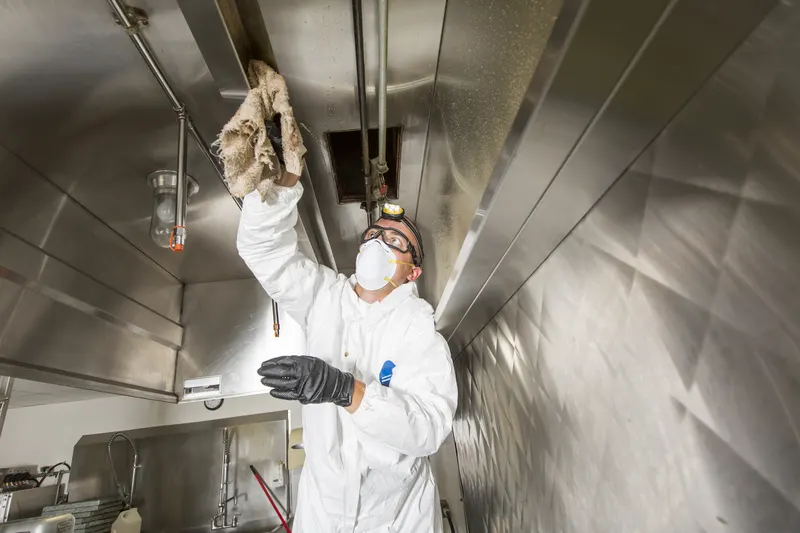
That one sentence is the whole legal link. The Fire Code is the regulation. NFPA 96 supplies the detail it points to: what gets inspected, how often, to what depth and what gets written down. So fire code compliant hood cleaning in Ontario means cleaning to the published NFPA 96 standard and keeping the record. The regulation is free to read on CanLII, Ontario Fire Code O. Reg. 213/07.
The work is on the commercial hood cleaning, kitchen exhaust cleaning and exhaust fan repair pages.
What a fire inspector asks to see in a Greater Sudbury kitchen
Greater Sudbury Fire Services enforces the Ontario Fire Code across the city, from the downtown core to Capreol, Valley East, Chelmsford and Lively.
An inspection of the exhaust system usually starts with paper. Expect to be asked for the most recent cleaning record. The inspector reads which sections it names and the date. A record that says only "hood" raises the question of whether the duct and fan were ever opened. From there, the inspector may look up behind the filters at the plenum, check that duct access panels can be reached, and ask whether the rooftop fan can be opened.
Fire services enforce the code. They do not issue cleaning certificates and they do not endorse contractors. Your certificate is evidence you hand over, and the inspector weighs it with what they see.
| Town | Fire service enforcing the Ontario Fire Code |
|---|---|
| Greater Sudbury | Greater Sudbury Fire Services |
| North Bay | North Bay Fire and Emergency Services |
| Sturgeon Falls | West Nipissing Fire Service |
| Espanola | Espanola Volunteer Fire Department |
| Little Current | Northeastern Manitoulin and The Islands Volunteer Fire Department |
| Elliot Lake | City of Elliot Lake Fire Department |
| Sault Ste. Marie | Sault Ste. Marie Fire Services |
| Timmins | Timmins Fire Department |
| Temiskaming Shores | Temiskaming Shores Fire Department |
Top-rated NFPA 96 hood cleaning in Sudbury: what the certificate should say
A hood cleaning certificate records that named sections of one exhaust system were cleaned on one date by one contractor, with reference to the published NFPA 96 standard. It does not record a passed fire inspection or an approval from NFPA.
What it asserts. The sections cleaned, named one by one: canopy, filters, plenum, horizontal duct, riser, fan. The date of the work. The condition found. A signature. Sudbury Commercial Hood Cleaning issues a signed health and safety certificate referencing the published NFPA 96 standard, backed by before-and-after photographs of every cleaned surface.
What it does not assert. It is not a fire inspection and it is not a pass. It says nothing about a section it does not name, so a certificate that lists only the hood covers only the hood. It also does not make anyone "NFPA approved", because NFPA does not approve cleaning contractors.
Is there a certified hood cleaning company in Sudbury?
A certified hood cleaning company is not a credential any body issues in Ontario. NFPA writes standards and does not certify contractors, the Ontario Fire Code does not license hood cleaners, and fire services do not endorse them.
Here is what to ask for instead. Ask for a signed certificate that names each section cleaned and references the published standard. Ask for before-and-after photographs of every cleaned surface. Ask for proof of WSIB coverage and liability insurance before work starts. Those three things are checkable. A claim of NFPA certification describes a credential NFPA does not issue.
Where to find NFPA 96 hood cleaning near me in Sudbury
Sudbury Commercial Hood Cleaning reads kitchens across Greater Sudbury and the route-day towns against the published standard during a free walk-through, and puts the finding in writing.
For context, a single-hood kitchen up to ten feet is cleaned from $585 per visit. Kitchen types are on the who we serve page, towns on the areas served page, and every service on the hood cleaning services page.
Next step: call 705-302-1378 or request a written quote. Have your last cleaning certificate on hand if you have one.
NFPA 96 in Sudbury: frequently asked questions
Which edition of NFPA 96 applies in 2026?
The 2024 edition of NFPA 96 is current. A newer edition is in development but has not been published, so the 2024 edition is the one cleaning work is read against.
Does NFPA 96 apply to a Legion or church kitchen that cooks a few times a month?
NFPA 96 applies to commercial cooking that produces grease-laden vapour, however often it runs. Churches, day camps, seasonal businesses and senior centres are the examples the standard gives for the annual interval.
Why is a camp kitchen on the quarterly interval?
A camp kitchen that cooks for rotational shifts around the clock is high-volume cooking under NFPA 96, and high-volume cooking carries a quarterly interval. The hours and the appliances set the row, not the headcount.
What does the 0.078 inch figure mean?
The 0.078 inch figure is the grease deposit depth NFPA 96 sets as the cleaning trigger, about two millimetres. A surface at or past that depth is due for cleaning.
Is a hood cleaning certificate the same as passing a fire inspection?
A hood cleaning certificate is the contractor record of what was cleaned and when. A fire inspection is the fire service check of the kitchen, and the inspector reads the certificate as one piece of evidence.